.png)
We believe the field of humanities communications is the bridge between the present and the future of humanities work and that work needs everyone to move it forward.


Christine Hensenler is the Co-founder and Co-President Center for Humanities Communication (CHC). She is a Professor Emeritus of Spanish & Hispanic Studies at Union College, NY. Throughout my tenure at Union College, I have been driven by one central question: How can we expand students' understanding of the value of a humanities degree in their lives and careers? The arts and humanities aren't just "electives"—they are the essential heartbeat of a sustainable, innovative, and equitable society. However, I recognized a critical gap: institutions and nonprofits are constantly reinventing the wheel, fighting common misconceptions with scarce resources and little to no specialized communications expertise. To address this, I co-founded the Center for Humanities Communication (CHC) to centralize our advocacy efforts, offering shared materials and training to effectively communicate the importance of the humanities to public audiences. To bridge the gap between high-level advocacy and the youth audience, I co-direct a multilevel program at the CHC called the Student Engagement Program (SEP). The SEP actively transforms student perceptions of the humanities by meeting Gen Z and Gen Alpha where they are. Through this program, we equip a diverse network of students from K-12 through college to reframe the humanities using joyful, evidence-based storytelling. Our "Humanities Forward" strategy anchors all communication in a deep understanding of youth concerns and the definitive demands of the Future of Work. By continuously monitoring student-to-student discussions on social media, we listen to the conversation to understand their real questions regarding the value of a humanities degree. We then speak their language, actively debunking myths by using the same platforms and communication practices that students use among themselves. Rather than relying on passive information delivery, the SEP engages students through action, utilizing gamification, play, and active learning experiences. Finally, we build knowledge strategically by investing in humanity-centered, interdisciplinary research to ensure our methods are always grounded in current realities. Ultimately, the SEP integrates practice and purpose, turning misunderstood disciplines into clear, strategic professional pathways.

Alan Liu is Distinguished Professor Emeritus of English at University of California, Santa Barbara, where he taught from 1987 to 2025, and has been Chair, Graduate Chair, and Undergraduate Chair of the English Department. Previously, he was on the faculty of Yale University’s English Department. Liu began as a scholar of British romantic literature and art. His first book, Wordsworth: The Sense of History (1989), explored the ambivalent relation between the imaginative experience of literature and the sense of history in the period of the French Revolution. In a series of theoretical essays in the 1990s, he explored the “new historicism,” cultural criticism, and postmodernism. Subsequently, he turned to the digital humanities, starting his Voice of the Shuttle website for the humanities in 1994; the UCSB Transcriptions Center for digital humanities and new media in 1998; and the UC multicampus Transliteracies Project on online reading in 2005-2010. His monographs on the digital humanities and the information age (and our digital era’s missing, or transformed, sense of history) include The Laws of Cool: Knowledge Work and the Culture of Information (2004); Local Transcendence: Essays on Postmodern Historicism and the Database (2008), and Friending the Past: The Sense of History in the Digital Age (2018). He also co-edited Critical Infrastructure Studies and Digital Humanities (2026) for U. Minnesota Press’s Debates in the Digital Humanities book series. As chair of the Modern Language Association’s Committee on Information Technology in 2022-23, he was lead author of the MLA’s 2024 Guidelines for Evaluating Digital Scholarship. Throughout his career, Liu braided together his scholarly activity with work in the public humanities. He founded the 4Humanities.org advocacy initiative, which uses digital humanities to speak up for the humanities; led the Mellon Foundation-funded "WhatEvery1Says" project, which applies big-data computational methods to study how the humanities are perceived in public; and co-founded the Center for Humanities Communication, where he serves as one of the leadership group (focusing especially on strategic planning and grant seeking) and directs the CHC’s development initiative in using AI and digital humanities for humanities communication.

Kath Burton is the founder of Radically Hopeful, a publishing strategy practice committed to building a more equitable and creative scholarly communication landscape. Burton spent over two decades inside academic publishing, including senior roles at Routledge, Taylor & Francis, where she shaped global humanities and social sciences programs, and it was precisely that insider knowledge that led her towards Humanities Communication. She watched brilliant scholars disappear into formats that flattened their ideas, and communities of researchers who had everything they needed to share their work, except a clear path forward. That gap is where Radically Hopeful began and where Kath's practice and approach now operates at the intersection of creativity and community. Her facilitation practice is grounded in the conviction that research and scholarship are creative acts as much as intellectual ones and that the right engagement strategy starts not with outputs, but with the person doing the work. She has designed open research programmes at scale, led participatory research into how scholarly work reaches public audiences, and built workflows that help researchers find their way from insight to impact. Whether she is working with early-career researchers or established practitioners, her approach is the same: evidence-based, genuinely responsive, and oriented toward possibility. She creates conditions where people can think clearly, work bravely, and find their way forward with renewed purpose. Always with and for the Humanities and humanistic Social Sciences. Often combining the transformational power of community gardening with the structures and principles of scholarly communication. She holds an MA in African Studies and a BA in English Language and Literature. As Co-Director of the Scholars Program, she is working alongside Anke Finger to facilitate communication change for humanities scholars at every level who are ready to do their most meaningful work - shared with joy and creativity. Find out more about Kath's current work here and connect via LinkedIn, BlueSky or Instagram ORCiD: 0000-0001-7785-9604
Anke Finger is Professor of German Studies, Media Studies, and Comparative & Literary and Cultural Studies at the University of Connecticut. As the inaugural director of the graduate certificate in Digital Humanities and Media Studies and the director and co-director of two dual degree programs between German Studies and Business (EUROBIZ) as well as Engineering (EUROTECH), she practices and employs Humanities Communication on a daily basis, inside and beyond academia. Finger is a specialist in thinking and writing across disciplines: comparative literatures, comparative media and arts, and bridging humanities and sciences across cultures). She teaches and published in a variety of areas, on the idea of the Total Artwork, bias in communication, media literacy, philosophy and AI, and intercultural communication. She joined the CHC following a startling encounter at a humanities conference: why would colleagues limit their immense communication abilities to only writing for other academics? She realized that benchmarks, metrics, and data points in the humanities needed more creativity, joy, avowal and agency – in addition to better stories and narratives. As the Co-Director of the Scholars Program, she is working alongside Kath Burton to facilitate communication change for academics at all levels ready to break out of ill-fitted molds in the Humanities. For more information on Anke’s academic work, please visit her here. [Anke’s U. Connecticut web page]

Stephanie Toxqui has been a CHC Research Assistant for the Student Engagement Program for more than two years. Toxqui is a student at Rutgers University, majoring in English with a minor in Foundations of Urban Education. She holds an Associate’s degree in Teacher Education from Passaic County Community College. Since 2024, Stephanie has served as a Student Support Intern at Braven, actively empowering college students with career-connected learning and instilling in them the confidence to enter their desired field of work. In 2023, she received an International Distinguished Research Project Award from the Phi Theta Kappa Honor Society for co-chairing a humanities-based undergraduate research project that explored constructs hindering students’ self-expression through play. Through her experience working in non-profit organizations and higher-educational spaces, she understands the value of using communication, collaboration, and community to uplift others. She strongly desires to aid and champion students in receiving interdisciplinary career guidance that aligns with their passions. As a Research Assistant for the CHC’s Talking Points Toolbox, Stephanie aims to support and advocate for humanities communications by curating accessible and diverse resources related to the humanities.
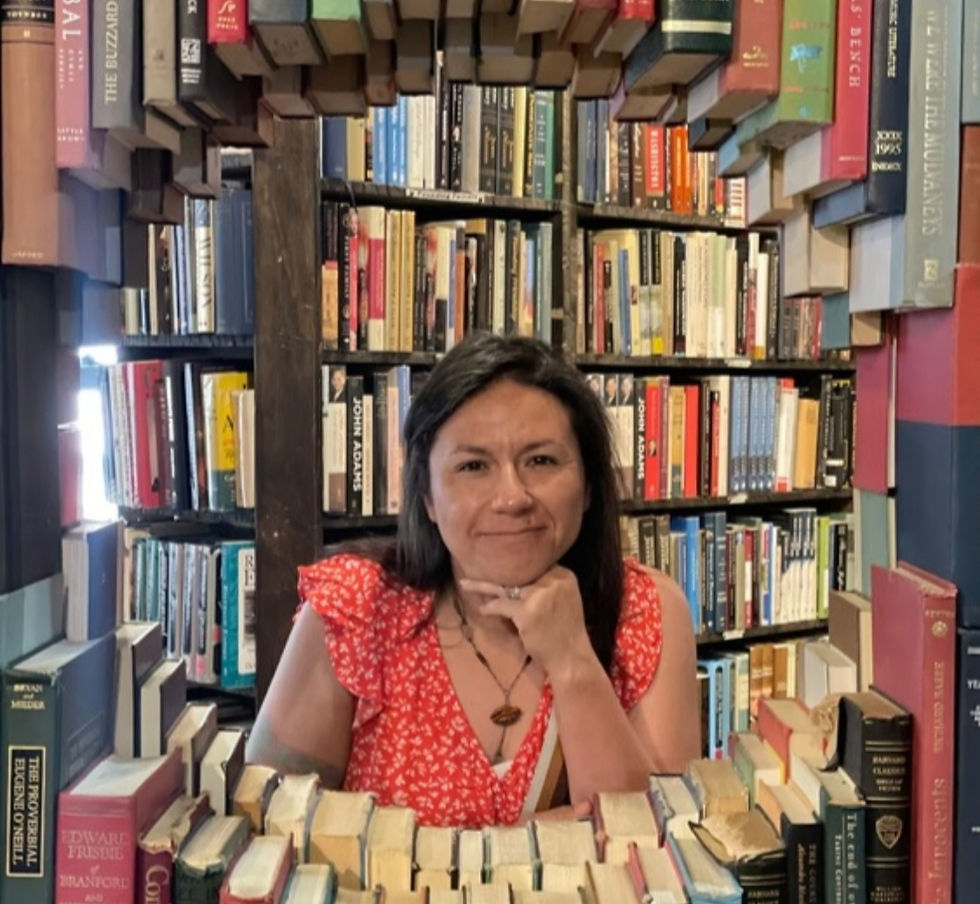
Catalina Sofia Dansberger Duque leads CHC's communications and Co-Directs the SEP program with Christine Henseler. In 2011, I founded Policarpa Media Studios, a strategic communications practice supporting organizations in clarifying their mission, strengthening narrative systems, and amplifying their public voice through integrated editorial, digital, and multimedia communications. Her work emphasizes strengths-based storytelling and the role of communications in shaping institutional identity, public understanding, and engagement. Dansberger Duque is a leader whose work focuses on how institutions and communities tell stories of identity, creativity, and impact across cultures and disciplines. She brings extensive experience in higher education, research communications, and mission-driven organizations, with a focus on translating complex ideas into accessible narratives that engage diverse public audiences. Dansberger Duque's work centers on developing storytelling frameworks that connect people, programs, and ideas across institutional and cultural boundaries. She has led communications strategy, editorial development, and multimedia storytelling initiatives involving faculty, researchers, artists, entrepreneurs, and community partners across higher education and independent practice. Throughout her career, I have collaborated with diverse communities and institutions to develop communications that reflect both lived experience and scholarly inquiry, with a consistent focus on clarity, inclusion, and the responsible representation of complex social and cultural narratives.